By Valerie Hickey, Senior Biodiversity Specialist at the World Bank
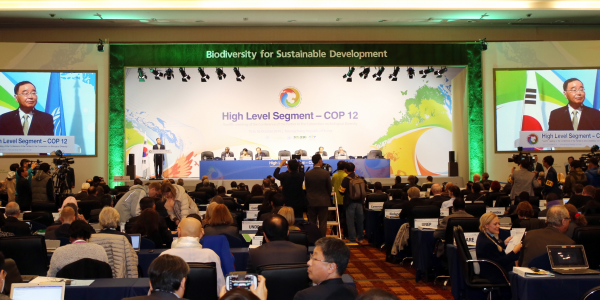
November 8, 2014 – I recently returned from Pyeongchang, South Korea where I attended the 12th meeting of the Conference of the Parties to the Convention on Biological Diversity (COP 12). I am delighted to report that it as much a “development” COP as a biodiversity COP, positioning biodiversity as a solutions-provider in the post-2015 development agenda. This was not a Trojan horse tactic to achieve conservation by other means; it really was about, as the COP was aptly titled, “Biodiversity for Sustainable Development”.
In panel after panel, and throughout even the high-level plenaries, one message rang loudest: the strong interlinkage between poor natural resources management, depleted biodiversity and impacts on growth and development. The conversation was starkly different from ones of the past: we no longer spoke about growth or development as a threat to biodiversity, but rather about how conservation, sustainable use and access and benefit sharing can drive poverty alleviation, foster inclusive green growth, and promote resilience in a warming world.
 In transitioning from the constituency of no – “No, you can’t build that here! No, you can’t develop that there!” – to a broader and more inclusive constituency of “Yes, we can help you build that better, develop that faster and make it more resilient,” natural capital accounting (NCA) emerged as the key tool that helped shape and shift the conversation towards solutions.
Perhaps the key shift that NCA has made happen is this: for the last few decades, the conversation has always posited that biodiversity is a global public good. But it is more than that — it is a national asset that can be managed to provide long-term, sustainable and growing rewards to communities and countries. Wildlife and coral reef tourism drive growth in dozens of countries, and deliver large and otherwise irreplaceable sums of foreign and hard currency. Off-farm ecosystem services underpin on-farm productivity, ever more important as we will need to feed 9 billion people by 2050, while in many of the poorest countries, wild protein from land and sea remains a primary source of protein.
 This is what NCA does best: it provides the language to connect environment and economics in terms that are readily understood: jobs and GDP. The World-Bank led Wealth Accounting and Valuation of Ecosystem Services partnership (WAVES) has done this in several cases, from showing the loss in revenues from illegal logging in Guatemala, to the implications for jobs of managing water assets differently in Botswana and for managing the demands on land use in biodiversity-rich regions in the Philippines.
And NCA is not just about public accounting. It is also growing as a critical tool of risk management for the private sector and finance industry. Investment decisions for many companies and risk accounting for many banks hinge more and more on the long term outlook and availability of the necessary inputs to business, many of which are provided by nature. Think water for brewing or pollination for agri-business. As a result, just as WAVES is working with governments, the Natural Capital Coalition (NCC) is working with private businesses and the Natural Capital Declaration (NCD) with the financial sector. Together NCA, NCC and NCD can operationalize the reality that resource mobilization for biodiversity is about investment capital, not sunk costs. It is about risk management, long-term growth and wealth generation.
That’s why at Pyeonchang we committed to convening a meeting in early 2015 to align NCA, NCC and NCD and optimize results at the policy interface across landscapes and seascapes. This would fundamentally move the needle on progress under Goal A of the Aichi Targets. And as we all meet again in Sydney next week for the World Parks Congress and begin planning for the next COP in Mexico in 2016, we hope this discussion across the public-private spectrum will continue to move us all closer to unlocking the level of resources necessary to build-back the stock of biodiversity that can in turn catalyze accelerated inclusive, evergreen growth for families, communities and countries.